China has become a major sourcing base for charging accessories, including the Dual Usb C Charger. Its factories offer broad model choices, private labeling, and scalable production. Yet lower pricing alone does not prove dependable quality.
IDC’s Worldwide Quarterly Mobile Phone Tracker reported approximately 1.24 billion smartphone shipments in 2024. That large installed base continues to support demand for compact, multi-port charging equipment. The European Commission also requires USB-C charging for many portable devices from December 2024, with laptops included from April 2026. These changes make connector compatibility increasingly important for global buyers.
Jeff Ravencraft, USB Implementers Forum President and COO, described USB Type-C as “the emerging industry standard connector for delivering data and power to computing and consumer devices.” His statement reflects the market’s direction, but charger selection still requires careful verification. A 65W label may not mean 65W on both ports. Cable ratings, thermal control, Power Delivery profiles, and safety certifications need independent review.
This guide examines China’s top Dual Usb C Charger manufacturers through a buyer’s lens. It considers factory experience, testing systems, customization capability, production consistency, and export support. Practical details matter: clear wattage markings, stable charging beside a laptop, and a cool adapter after extended use.
Some supplier claims remain difficult to compare. That is an uncomfortable gap. Buyers should request test reports, sample units, factory audits, and warranty terms before placing large orders. A polished catalog is only the beginning.
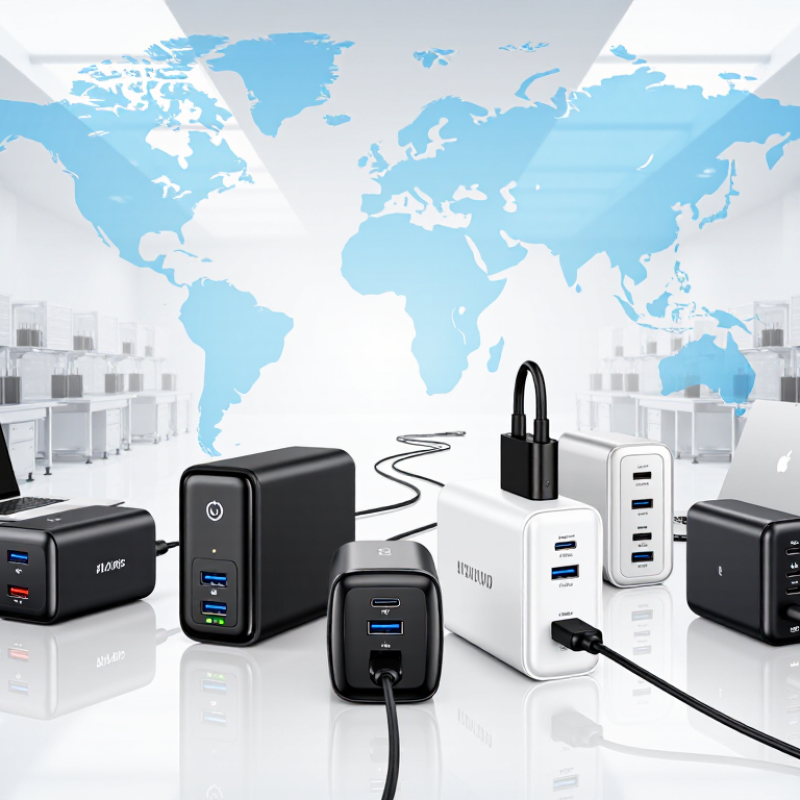
A top dual USB-C charger manufacturer in China is defined by engineering discipline, not a polished product sample. Experienced factories understand USB Power Delivery, thermal design, component aging, and power-sharing behavior. The USB Implementers Forum states that USB PD 3.1 can support charging up to 240 watts. However, dual-port performance depends on stable allocation, not only maximum output.
Professional manufacturers validate chargers under realistic conditions. They test both ports together, measure heat near the connector, and inspect voltage changes during fast charging. Independent certification and traceable production records also matter.
A reliable supplier should therefore provide durable designs, replaceable packaging materials, and clear recycling information. Small details matter. A loose port can damage trust quickly.
Tips: Request a factory audit, recent safety reports, and dual-port load-test records. Ask for samples from normal production, not only engineering units. Review protection features, including over-temperature, over-current, and short-circuit controls. No factory is flawless. A supplier that openly discusses failure rates may be more trustworthy than one promising zero defects. Test performance at room temperature and after continuous use. That is where weak designs often appear.
China’s dual USB-C charger manufacturing base is concentrated in several practical hubs. Shenzhen supports rapid product development, dense component sourcing, and engineering teams familiar with compact power designs. Dongguan adds strong capabilities in injection molding, assembly, packaging, and production-line automation. In the Yangtze River Delta, factories often connect charger production with precision tooling, power electronics, and export logistics.
Capabilities vary widely.
Experienced suppliers can design dual-port power allocation, GaN-based thermal systems, and compact circuit layouts. They usually operate SMT lines, aging-test rooms, programmable load equipment, and safety inspection stations. Buyers should request test records for overheating, short circuits, voltage stability, and simultaneous port loading. A factory may show an attractive sample, yet its mass-production controls may remain weak. This gap deserves attention.
Reliable manufacturers explain their component sources, firmware controls, and quality checkpoints without vague promises. Ask whether the same engineering team supports sampling and production. Check factory audit reports, batch traceability, packaging durability, and independent compliance documentation for target markets. Some suppliers respond quickly but provide incomplete technical files. That is not always disqualifying, but it signals follow-up work. Production capacity should also be verified through equipment counts, shift plans, and recent order evidence, rather than a polished showroom.
For global buyers, a dual USB-C charger should be judged by verified standards, not a polished housing. The USB Implementers Forum states that USB Power Delivery 3.1 can support up to 240 watts. However, a compact two-port unit rarely needs that ceiling. Procurement teams should match advertised output with port behavior, PPS support, cable ratings, and thermal limits. A compliance file should identify the exact model, revision, and testing scope. Small details matter.
Electrical safety deserves separate attention. IEC 62368-1 addresses safeguards against electric shock, fire, and energy-related hazards. For products entering Europe, EN IEC 62368-1 testing should support applicable CE technical documentation. Buyers should request reports covering abnormal operation, dielectric strength, leakage current, temperature rise, short circuits, and overload. A certificate without a traceable report is weak evidence. In practical sourcing, finished-carton sampling can miss solder defects or inconsistent insulation.
Quality control should follow the charger through production. Incoming inspection can verify capacitors, transformers, controllers, and USB-C connectors against approved specifications. In-line tests should include polarity, grounding, output negotiation, and port-sharing under load. Final sampling should include aging tests, not only visual checks. The European Commission’s common-charger impact assessment estimated that harmonized charging could reduce electronic waste by about 11,000 tonnes annually. That figure shows why reliability matters beyond one shipment. Factory data can still be incomplete. Independent audits, retained samples, and periodic re-testing provide stronger confidence.
How to Compare China’s Dual USB-C Charger Manufacturers
China’s dual USB-C charger market is competitive, but specifications can look deceptively similar. Grand View Research’s 2024 USB charger analysis estimates a 6.6% CAGR through 2030. This growth increases supplier choices and quality differences.
Compare output behavior, not only the maximum wattage. Ask for independent tests covering USB-C Power Delivery, PPS support, thermal stability, and power sharing. A 65W charger may deliver 45W and 20W together, rather than 65W to one device. Check whether the supplier provides test reports, component traceability, factory audit records, and samples from separate production batches. USB-IF specifications can help verify protocol claims. However, compliance paperwork alone is not enough. I have seen impressive samples fail after repeated heat cycles.
Tips: Request a three-device load test. Measure output after 30 minutes. Check surface temperature, cable compatibility, standby consumption, and recovery after overload protection. Ask for the actual bill of materials, not a marketing sheet. Use an accredited laboratory when sales volume justifies the cost.
Future Market Insights identifies compact GaN designs and multi-port charging as major market growth factors. Still, GaN does not automatically mean better reliability. Compare switching noise, insulation design, connector strength, and warranty data. Review failure rates by batch, replacement procedures, and response times. A supplier that admits a weak point may be more dependable than one promising perfection. Cenforce this judgment with evidence.
Use this USB Power Delivery reference chart to compare charger manufacturers’ technical claims. Standard Power Range (SPR) fixed-voltage profiles are shown at up to 3A, while Extended Power Range (EPR) profiles are shown at up to 5A. Buyers should verify the advertised profiles, total dual-port output, thermal performance, safety certifications, and test reports before selecting a supplier.
Reference basis: USB Power Delivery fixed-voltage ranges and maximum current limits published in USB-C and USB PD specifications. The wattage values are calculated as voltage × current.
Global buyers evaluating dual USB-C chargers should treat OEM and ODM as engineering choices, not labels. OEM suits fixed designs, while ODM allows changes to ports, housing, firmware, and packaging. Request input and output matrices, PPS ranges, thermal derating curves, and USB-C compliance records. The USB Implementers Forum requires testing for official certification, so verify every supplier document. Details matter. The Global E-waste Monitor 2024 reported 62 million tonnes of e-waste in 2022, with only 22.3% formally collected and recycled. Ask for recyclable packaging and evidence-based environmental claims.
Pricing should separate power components, tooling, certification, packaging, and inspection. A practical mistake is trusting the lowest unit quotation. It may hide tooling fees or costly air freight. For 35W or 65W models, compare efficiency, heat, standby power, and port-sharing performance under simultaneous loads. Use a pilot order before annual commitments. That gap matters. Industry forecasts rarely reflect your connector mix or regional packaging requirements.
Global shipping needs more than an FOB number. Ask for carton dimensions, gross weight, pallet count, HS classification, dangerous-goods screening, and destination testing requirements. The World Bank Logistics Performance Index 2023 shows major differences in customs, infrastructure, and delivery reliability. Build landed-cost scenarios for sea, rail, and air freight, including insurance and port delays. EU common-charger rules cover many portable devices from December 28, 2024, while laptops follow from April 28, 2026. Requirements change. Confirm regional obligations before approving artwork or mass production.