Leave Your Message

Top 10 USB Outlet Plug Types for Global Buyers?

Choosing a Usb Outlet Plug is no longer a simple matter of matching voltage and shape. Travelers, distributors, and project buyers now compare charging speed, socket compatibility, safety certification, and installation depth. A plug that looks universal may still fail with a loose faceplate, limited USB output, or poor heat control. Small details matter.

Industry reports show why this category deserves closer attention. Grand View Research estimates that the global USB charger market was worth approximately USD 34.93 billion in 2023, with continued growth expected through 2030. MarketsandMarkets also identifies faster adoption of USB Type-C and high-power charging as important market drivers. These figures cover broader charger segments, not only wall outlets. That limitation should be acknowledged. Still, the direction is clear.

Jeff Ravencraft, USB Implementers Forum president and COO, has described USB Type-C as “the future of connectivity.” His view reflects a practical shift: buyers increasingly expect one compact outlet to support phones, tablets, laptops, and travel accessories. However, “universal” is not always universal. Regional socket geometry, grounding methods, frequency, and certification requirements remain different. A reliable comparison must examine these points carefully. This guide reviews ten Usb Outlet Plug types for global buyers, from Type A combinations to Type C and multi-standard units. It considers real installation conditions, including crowded hotel desks, recessed boxes, and warm charging adapters. The ranking is useful, but not perfect. Product specifications change, and local approval should always be verified before purchase.
Top 10 USB Outlet Plug Types for Global Buyers?

How USB Outlet Plugs Work and Why Global Standards Differ

Top 10 USB Outlet Plug Types for Global Buyers?

How USB Outlet Plugs Work and Why Global Standards Differ

A USB outlet plug combines mains wiring with a low-voltage charging circuit. The wall side accepts regional voltage and frequency. The USB side converts that power into controlled direct current. IEC research identifies 15 domestic plug and socket types worldwide. Shapes differ because national systems evolved separately, not because one design failed. Type A outlets often serve 100–127V networks, while many Type C, G, and I systems support around 220–240V. Check the label carefully. A familiar socket shape does not guarantee electrical compatibility.

The USB Implementers Forum’s USB Power Delivery 3.1 specification allows negotiated charging up to 240W. Most wall outlets deliver far less. A phone may request 5V, while a laptop can request higher voltage only after communication between charger and device. This negotiation helps reduce overheating, but it cannot correct poor installation or unsafe wiring. European Union common-charger rules also require USB-C for many portable devices from December 2024, with laptops included from April 2026. Regulations are converging slowly. They are not identical everywhere.

Tips: Match the outlet’s input rating with local voltage. Prefer certified products tested to relevant IEC or national standards. Check USB-C output profiles, not only wattage. Leave clearance around the outlet. In practice, buyers sometimes trust appearance too quickly. That mistake deserves more attention.

Top 10 USB Outlet Plug Types for Global Buyers? - How USB Outlet Plugs Work and Why Global Standards Differ

Rank Plug / Socket Type IEC 60083 Reference Common Markets Typical Nominal Supply Earthing and Contact Arrangement Common Integrated USB Configuration Key Buyer Consideration
1 Type A Flat parallel blades; unearthed United States, Canada, Mexico, Japan and several Central American countries Usually 100–127 V; 50 or 60 Hz depending on country Two flat blades; no dedicated protective-earth contact USB-A plus USB-C; USB-C Power Delivery is commonly available in newer products Check blade dimensions and electrical approval because North American and Japanese versions are not identical in every detail.
2 Type B Flat parallel blades with grounding pin United States, Canada, Mexico, Japan and parts of Central America Usually 100–127 V; 50 or 60 Hz depending on country Two flat blades plus a grounding pin; commonly rated 15 A in North America USB-A, USB-C, or a combined USB-A/USB-C module Use a grounded USB receptacle where the installation requires grounding; USB charging does not replace protective earthing.
3 Type C Two round pins; unearthed Much of continental Europe, parts of Africa, the Middle East and Asia Commonly 220–240 V, 50 Hz Two round pins with no earth contact; often used with low-power, double-insulated devices USB-C is increasingly preferred; USB-A plus USB-C remains common in retrofit modules Type C is not a universal replacement for grounded sockets and is often used with compatible E, F, or other local socket systems.
4 Type E Round pins with socket-mounted earth pin France, Belgium, Poland, Czechia, Slovakia and several nearby markets Commonly 220–240 V, 50 Hz Two round power pins; protective earth is provided by a pin fixed in the socket USB-A/USB-C modules designed for flush wall boxes and grounded installations Confirm that the outlet geometry accepts the local earthing arrangement and that the USB module is rated for the local mains voltage.
5 Type F Round pins with side earthing clips Germany, Austria, the Netherlands, Spain, Portugal, Sweden and much of continental Europe Commonly 220–240 V, 50 Hz Two round power pins with protective-earth clips on both sides; commonly rated up to 16 A USB-C Power Delivery, USB-A, or combined USB-A/USB-C grounded outlets Ensure the product preserves side-contact earthing and fits the required wall-box depth.
6 Type G Three rectangular pins; grounded United Kingdom, Ireland, Cyprus, Malta, Malaysia, Singapore and Hong Kong Commonly 220–240 V, 50 Hz Three rectangular pins; the earth pin also operates the socket safety shutters USB-A plus USB-C, commonly integrated into 13 A switched or unswitched sockets Check fuse requirements, shutter operation, mounting-box dimensions and the applicable national approval.
7 Type I Two angled flat blades; optional earth pin Australia, New Zealand, China and Argentina Usually 220–240 V, 50 Hz; China commonly uses 220 V, 50 Hz Two angled blades; grounded versions add a vertical earth pin; current ratings vary by market USB-A/USB-C combinations; USB-C output is increasingly used for higher-power charging Do not assume all Type I versions share the same current rating, dimensions or certification requirements.
8 Type J Three round pins; grounded Switzerland and Liechtenstein Commonly 230 V, 50 Hz Two power pins plus a recessed earth pin; typical household rating is 10 A Compact USB-A/USB-C modules designed for Swiss wall boxes Swiss sockets have distinct dimensions and should not be substituted with standard Type E or Type F products.
9 Type K Three round pins; grounded Denmark and Greenland Commonly 230 V, 50 Hz Two power pins plus a distinctive earth pin; household ratings depend on the specific installation USB-A or USB-C integrated outlets for locally compatible wall boxes Verify socket depth, earth-pin position and local approval before using a Type K replacement outlet.
10 Type L Three in-line round pins; grounded Italy, Chile, Libya and parts of North Africa Commonly 220–240 V, 50 Hz Three in-line pins; both 10 A and 16 A formats are used in Italy USB-A/USB-C modules available in 10 A, 16 A, or compatible combined formats Confirm whether the installation uses the 10 A or 16 A spacing; the two formats are not interchangeable in every socket design.
How USB outlet plugs work: An integrated USB outlet contains an AC-to-DC power supply behind the mains receptacle. It converts the local line voltage to a regulated USB output, typically 5 V for basic charging or a negotiated USB-C Power Delivery profile for higher power. USB port availability, charging power, grounding, wall-box depth and national safety approval must be checked separately from the visible plug shape.

The Ten Main USB Outlet Plug Types by Region and Electrical Standard

Top 10 USB Outlet Plug Types for Global Buyers

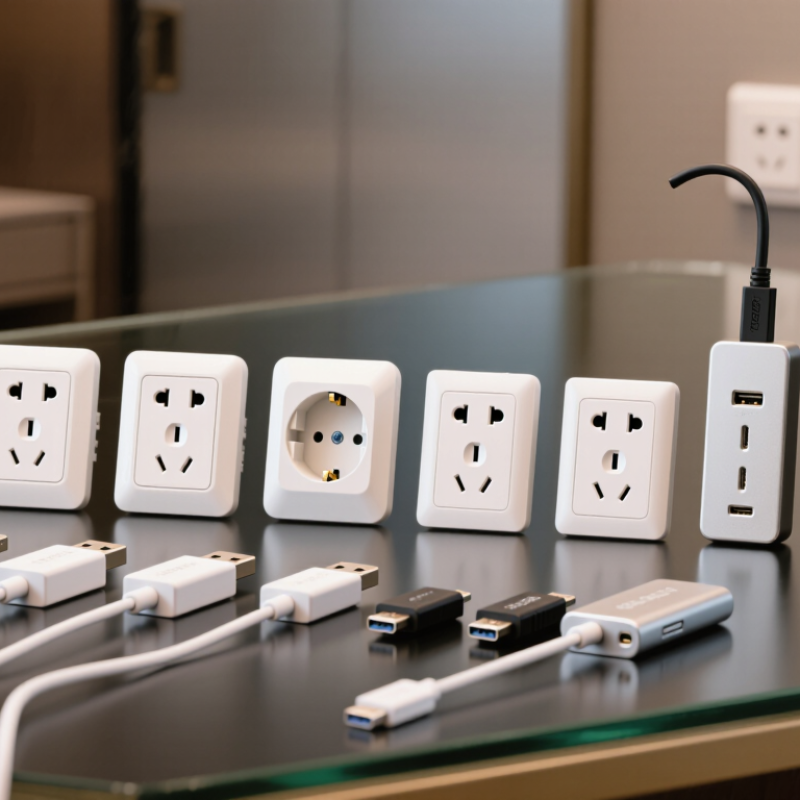
The ten main USB outlet plug types follow regional socket designs and electrical standards. Type A is common in North America and Japan, usually with two flat pins. Type B adds a grounding pin. These markets often use 100–127 volts, but Japan differs from North America.

Type C uses two round pins and appears widely across Europe, South America, and parts of Asia. Type E and Type F also serve European markets, with grounding differences. Type G is used in the United Kingdom and several nearby markets. It has three rectangular pins and normally operates at 230 volts. Type I covers Australia, New Zealand, China, and Argentina, although local requirements can vary. Type J is associated with Switzerland. Type K is mainly used in Denmark. Type L is common in Italy and uses three round pins. That makes ten important regional categories.

Choosing a USB outlet requires more than matching the front plate. Check voltage, frequency, grounding, box depth, shutter design, and USB charging output. A Type F installation may not accept every Type C product safely. Small details matter. USB-C ports can support modern devices, but their output ratings still differ. I have found regional charts useful, yet they can oversimplify mixed markets. Border areas and renovated buildings may contain older socket formats. Local certification should be confirmed before production or installation. A neat global table is helpful, but real buildings are less tidy.

USB Port Formats, Charging Speeds, and Built-In Safety Features

Global buyers are seeing more USB outlet plugs with USB-A, USB-C, or mixed ports. USB-A still suits older cables, while USB-C supports faster charging and reversible insertion. The USB Implementers Forum states that USB Power Delivery 3.1 can reach 240 watts with compatible equipment. However, the outlet’s total output matters. A two-port unit may share 30 watts between devices, slowing a tablet when a phone is connected.

Charging speed is not only about wattage. Programmable Power Supply can adjust voltage more precisely, helping compatible devices charge efficiently. A 2024 report from Mordor Intelligence estimated the USB charger market at over 30 billion US dollars. That growth reflects demand for compact, multi-device charging, but market size does not prove product quality. Check whether the specification lists independent port output, not only maximum combined output.

Safety deserves close attention. Look for overcurrent, overvoltage, short-circuit, surge, and thermal protection. Certified construction should also match relevant IEC requirements and the destination country’s socket standards. A warm faceplate is a warning sign, not a feature. My first buying checklist focused too heavily on charging speed. That was incomplete. A 65-watt label can still hide weak heat control, shared power, or poor cable compatibility. For hotel rooms, offices, and family kitchens, clear ratings and tested protection matter more than a crowded port layout.

How to Match USB Outlet Plugs with Devices, Wiring, and Local Codes

Top 10 USB Outlet Plug Types for Global Buyers

Choosing a USB outlet starts with the device, not the appearance. USB-A suits older cables, while USB-C supports newer phones, tablets, and laptops. Check the required charging power carefully. A small device may need 5 watts, but a laptop can require 45 watts or more. Power delivery ratings matter. A USB-C port with insufficient output may charge slowly or stop under load. I have seen buyers focus on port shape and overlook cable quality. That mistake is surprisingly common.

The wall plug must match local voltage, frequency, grounding, and socket dimensions. Type A, C, G, I, and other configurations are not interchangeable in practice. Confirm the outlet’s rated current before connecting appliances beside USB devices. Inside the wall box, check for a neutral wire, grounding conductor, and enough installation depth. Some USB outlets run warm, especially when several ports operate together. Heat around a shallow box deserves attention. A qualified electrician should verify connections and test polarity, grounding, and protective devices.

Local electrical codes can also control shutter protection, child safety, moisture resistance, and certification marks. Kitchens, bathrooms, and outdoor areas often require additional protection. Do not assume an imported outlet is acceptable because its plug fits. The USB module should have overcurrent, overvoltage, and temperature protection. Specifications can be incomplete. Recheck them against the actual device list, cable lengths, and daily charging habits. I would also leave spare capacity, because today’s perfect match may feel outdated next year.

Top 10 USB Outlet Plug Types for Global Buyers

How to match USB outlet plugs with devices, wiring, and local electrical codes

120 V families

Types A and B are commonly associated with 100–127 V systems, especially in North America and parts of East Asia. Verify the local voltage before selecting a USB outlet.

230 V families

Types C, D, E, F, G, I, J, and K are commonly used in 220–240 V systems. Type C is widely used but may not provide a protective-earth connection.

USB device matching

Check USB-C Power Delivery requirements, USB-A compatibility, total output wattage, charging-port count, and whether the outlet supports the device’s input voltage.

Wiring and codes

Confirm box depth, conductor size, grounding or earthing method, circuit protection, RCD/GFCI requirements, and certification rules with a qualified electrician.

Voltage values show common nominal supply systems associated with each plug type, not every permitted regional variation. Plug geometry and electrical standards are based on internationally used configurations and may differ by country.

Key Buying Criteria for International Residential and Commercial Projects

Top 10 USB Outlet Plug Types for Global Buyers

Choosing USB outlets for international projects requires more than counting charging ports. The plug format must match the destination’s wiring system, wall box, voltage, and frequency. Common options include Types A, B, C, E, F, G, I, J, K, and N.

For residential projects, Type A and B outlets suit North American installations. Types C, E, and F are widely used across European markets. Type G supports British-style systems, while Type I fits Australian, New Zealand, and several Asian applications. Types J, K, and N serve specific regional requirements. Regional compatibility matters. An attractive outlet can still fail during installation.

USB-C Power Delivery is valuable for modern homes, offices, hotels, and serviced apartments. USB-A remains useful for older devices. Check total output, shared charging limits, thermal protection, and standby power consumption. A device promising high output may slow when several ports operate together.

Safety should guide every specification. Confirm grounding, shutters, child protection, fire-resistant materials, and recognized local compliance marks. Commercial sites may also require tamper resistance, durable faceplates, and easy maintenance access. Measure the wall box depth before ordering; deeper units can conflict with existing cables. I have seen procurement teams overlook this detail.

Environmental conditions deserve attention too. Bathrooms, kitchens, and outdoor-adjacent areas may need suitable ingress protection. Installation instructions should be clear for local electricians. Translation errors can create real risks. A complete sample test is wiser than relying only on drawings. Specifications are important, but field conditions often disagree.